

Clinical Documentation for Primary Care Physicians: A Longitudinal Workflow
A primary care documentation workflow for multiple problems, chronic and preventive care, useful history, open loops, and timely review.
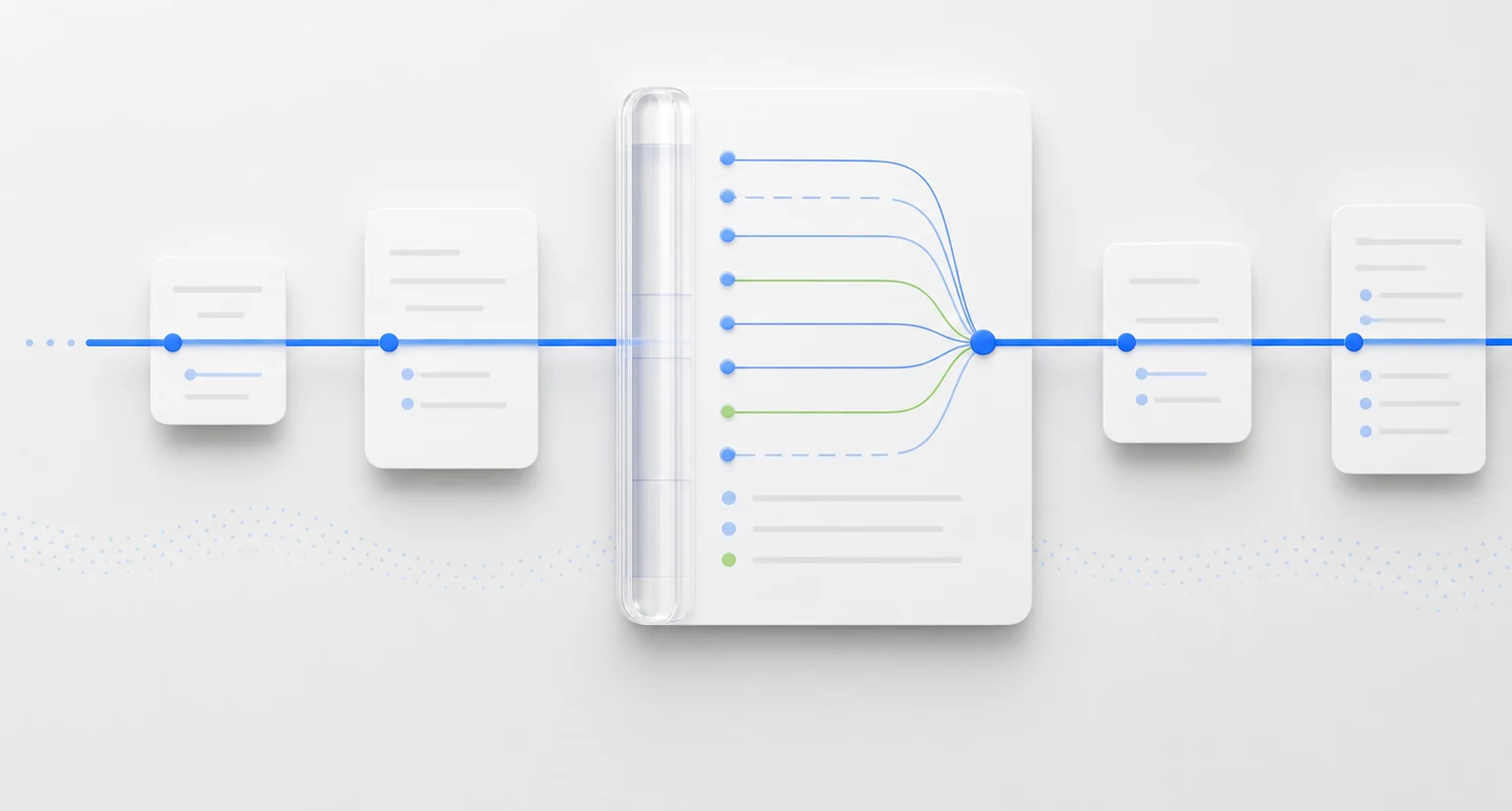
Clinical documentation for primary care physicians has to preserve a story that unfolds across years while explaining what changed today. One visit may combine a new concern, chronic conditions, medication decisions, prevention, outside care, and unfinished work.
The resulting note can fail in two opposite ways. A sparse note may omit the reasoning or next action that future care depends on. An overloaded note may repeat the entire chart until current priorities disappear inside old text. A better primary care workflow treats each encounter as a deliberate update to the longitudinal record: orient to the history, define today’s agenda, document what changed, and make every open loop visible.
Primary care documentation works across three time horizons
Primary care is not a sequence of isolated snapshots. The clinician needs to connect the current encounter to the patient’s prior trajectory and future plan. That work is increasingly complex: a CDC analysis of 2023 survey data estimated that 51.4% of U.S. adults reported two or more of 12 selected chronic conditions (CDC Preventing Chronic Disease). Multiple conditions do not simply require more words; they require a clearer model of what is active, stable, changing, or unresolved.
A useful note serves three time horizons:
- Before today: relevant diagnoses, trends, decisions, patient goals, prior response, and incomplete actions.
- Today: the agenda, new information, findings, assessment, decisions, and shared plan.
- After today: monitoring, tests, referrals, preventive actions, follow-up, and explicit ownership.
This structure supports informational continuity without pretending the note creates relational continuity. A systematic review of primary medical care found that nine of 12 studies measuring all-cause mortality reported a statistically significant protective association with greater continuity; the evidence was observational and mechanisms were not established (British Journal of General Practice). This does not show that longer notes improve outcomes. It supports making longitudinal knowledge usable to clinicians continuing the care.
Replace chart archaeology with a focused previsit orientation
Starting from a blank page wastes context. Starting from the previous note without checking changes can perpetuate stale information. A short previsit orientation should identify what the visit may depend on:
- The reason for the visit and outstanding agenda items.
- Active problems and meaningful trends.
- Recent medication changes, adherence concerns, and allergies.
- Relevant results, consultations, hospitalizations, and urgent care.
- Tests, referrals, preventive services, and symptoms still open.
- Goals or barriers likely to affect today’s plan.
A navigable patient visit history can help the clinician see what changed across encounters, but no timeline should be treated as automatically current. Verify important information with the patient and authoritative sources available in the approved record.
Primary care safety risks occur at those seams. An AHRQ review identified communication breakdowns, medication issues, diagnosis problems, and fragmentation as recurring threats, including missing context and poor test follow-up (AHRQ). Previsit review should surface decision-relevant gaps, not more copied history.
Define the agenda before the note expands
Multiple concerns can turn one note into several unfinished narratives. At the start of the encounter, identify the patient’s priorities, urgent issues, planned chronic-care work, and preventive needs. The clinician can then decide what can be addressed safely today and what needs a separate appointment or another team workflow.
This makes today’s scope understandable and keeps an unaddressed concern from appearing assessed. When an issue is deferred, record the plan and timing.
A simple working list can group items as:
- New or changing concern.
- Chronic condition requiring a decision or monitoring today.
- Medication reconciliation or safety issue.
- Preventive action due or discussed.
- Open result, referral, or symptom follow-up.
Adapt the list to the encounter, clinical judgment, and organizational policy; it is not a billing recipe.
Build a problem-oriented encounter update
The strongest primary care note is often not the longest. It helps the next reader distinguish current evidence from inherited text and action from background.
Keep subjective, objective, assessment, and plan aligned
For each problem addressed, connect the patient-reported course and relevant context to objective findings, the clinician’s assessment, and the next action. This SOAP note workflow offers a detailed method for keeping those sections consistent.
Useful alignment questions include:
- Does the history explain why this problem is being addressed today?
- Are measurements and findings dated or clearly associated with this encounter?
- Does the assessment represent the clinician’s current reasoning rather than an old label?
- Does the plan state what changes, what continues, and what requires follow-up?
- Can the reader tell which information came from the patient, an outside source, or direct observation?
Separate enduring context from today’s delta
Stable background belongs where it can be found without being republished as new. The encounter note should emphasize the delta: what the patient reports now, what changed in the data, what the clinician concluded today, and what happens next.
This matters because documentation burden and note bloat can reinforce each other. In a cross-sectional analysis of more than 203,000 ambulatory physicians, those in the highest note-length decile spent 39% more time in the EHR after hours and closed fewer visits on the same day than the median physician. Very low and very high use of templated text were both associated with greater burden (Health Services Research). The study shows association, not causation, and it does not establish an ideal note length. It does support reviewing whether repeated text is useful enough to justify the reading and writing burden it creates.
Document prevention as an accountable plan
Preventive care can disappear inside a copied health-maintenance list. If a service is discussed, completed, deferred, declined, or ordered, make its current status and next step clear. Do not imply that it was addressed because a template imported it. Keep the durable status in the appropriate EHR module and use the encounter note to explain today’s actions.
Close loops instead of merely listing them
Tests and referrals are processes, not one-time orders. The note should state what was ordered or recommended, why, the expected timing, who is responsible for review, how the patient will learn the result, and what to do if the action is not completed.
AHRQ’s closed-loop diagnostics learning lab describes failures to complete ordered tests, referrals, and symptom follow-up as persistent contributors to diagnostic error in primary care. Its work identified breakdown points across referral scheduling, radiology follow-up, laboratory monitoring, and evolving symptoms, and used system-level safety nets rather than relying on memory alone (AHRQ Patient Safety Learning Lab).
For referrals, AHRQ recommends sending the reason, pertinent history, medicines, and results; establishing a tracking process; confirming completion; and obtaining the report back into the record (AHRQ Health Literacy Universal Precautions Toolkit). The federal Clinical Communication SAFER Guide likewise focuses on reliable EHR-enabled communication for referrals, transitions, and clinician-to-patient messages (ASTP/ONC).
The encounter note contributes context to those systems. It should not be the only reminder that work remains open. The practice needs an operational queue or registry, coverage rules, escalation paths, and a named owner under local policy.
Create a realistic path to same-day review
In a time-motion study, primary care physicians averaged 16.5 minutes of face-to-face time without the EHR and 6.9 minutes of EHR work outside normal clinic hours per observed visit; out-of-hours work occurred in 64.6% of visits (Annals of Family Medicine). One setting is not a universal baseline, but the findings show why “finish later” is not a neutral design.
Build an explicit completion path:
- Preserve encounter context during or immediately after the visit through an approved method.
- Generate or write the first structured draft before details become a memory task.
- Reserve bounded review windows during the scheduled day where feasible.
- Confirm the patient, encounter, problem alignment, medicines, results, assessment, and plan.
- Move the clinician-approved content into the correct EHR encounter.
- Route results, referrals, messages, and preventive actions to the organization’s actual tracking systems.
Practices should pair any attempt to reduce after-hours charting with workload, staffing, inbox, and scheduling review. A documentation tool cannot correct chronic understaffing, an overloaded panel, unclear team roles, or more visit work than the schedule can hold.
Where ChartScribe fits in a longitudinal primary care workflow
ChartScribe can provide a consistent drafting layer while leaving the EHR as the final medical record. A clinician can record a patient conversation or upload an existing recording through an approved process, select a SOAP, DWI, intake, or custom template, and generate a structured editable draft. The clinician reviews, corrects, and completes that draft before copying finalized content into the EHR.
Patient assignment, visit history, and chart syncing across devices can help keep drafts associated with the intended longitudinal workspace. A practice might use a custom template that prompts for today’s agenda, problem-specific change, medication action, preventive status, open tests and referrals, owner, and follow-up interval.
Those features do not reconcile medicines, determine clinical priorities, diagnose or treat, verify that a referral occurred, monitor an EHR result queue, or finalize a medical record autonomously. ChartScribe also should not be described as directly integrated with the EHR: the clinician copies approved content into the correct encounter and verifies it there. Recording, access, retention, and device use remain subject to organizational controls, patient communication requirements, and applicable law.
A primary care final-review checklist
Before finalizing the chart, confirm:
- Identity and encounter: correct patient, date, visit, and source context.
- Agenda: addressed, deferred, and newly discovered concerns are distinguishable.
- Problem alignment: history, findings, assessment, and plan agree for each addressed problem.
- Longitudinal accuracy: old information is not presented as current, and meaningful changes are visible.
- Medicines and allergies: additions, discontinuations, dose changes, adherence concerns, and discrepancies are clear.
- Prevention: today’s discussion or action is separated from imported status.
- Open loops: tests, referrals, symptoms, and communications have a status, owner, and timeframe.
- Patient communication: instructions, follow-up, and clinician-specified escalation guidance are represented accurately.
- Record transfer: copied content appears in the correct EHR encounter without truncated or altered meaning.
Teams can adapt the more detailed chart-finalization checklist to their specialty, roles, and policy.
Measure usefulness across visits
Evaluate the workflow with more than note-production time. Review same-day completion, after-hours EHR activity, corrections, note length, copied text, missing owners, overdue results and referrals, and whether clinicians can find the current assessment and next action quickly. Sample charts for quality rather than assuming a closed note is a good note.
Any improvement measured after a ChartScribe pilot belongs to that practice, population, configuration, and study design. Research about EHR burden or other documentation systems is not evidence of a guaranteed ChartScribe result. The durable objective is simpler: each visit should leave the longitudinal record clearer than it found it, with today’s decisions visible and tomorrow’s work owned.