

Clinical Documentation for Mental Health Providers
A practical framework for writing nuanced, useful mental health notes while protecting sensitive information, patient trust, and psychotherapy-note boundaries.
Mental health documentation has to do several jobs at once. It should preserve the patient’s concerns and goals, show the provider’s clinical work, support continuity, and give the next authorized reader enough context to understand the plan. It must also handle deeply personal material with restraint.
That combination makes a behavioral health note different from a transcript. A session can move through history, metaphor, uncertainty, relationships, trauma, and emerging insight. The clinical record needs a faithful account of the care without turning every disclosure into permanent, broadly visible prose.
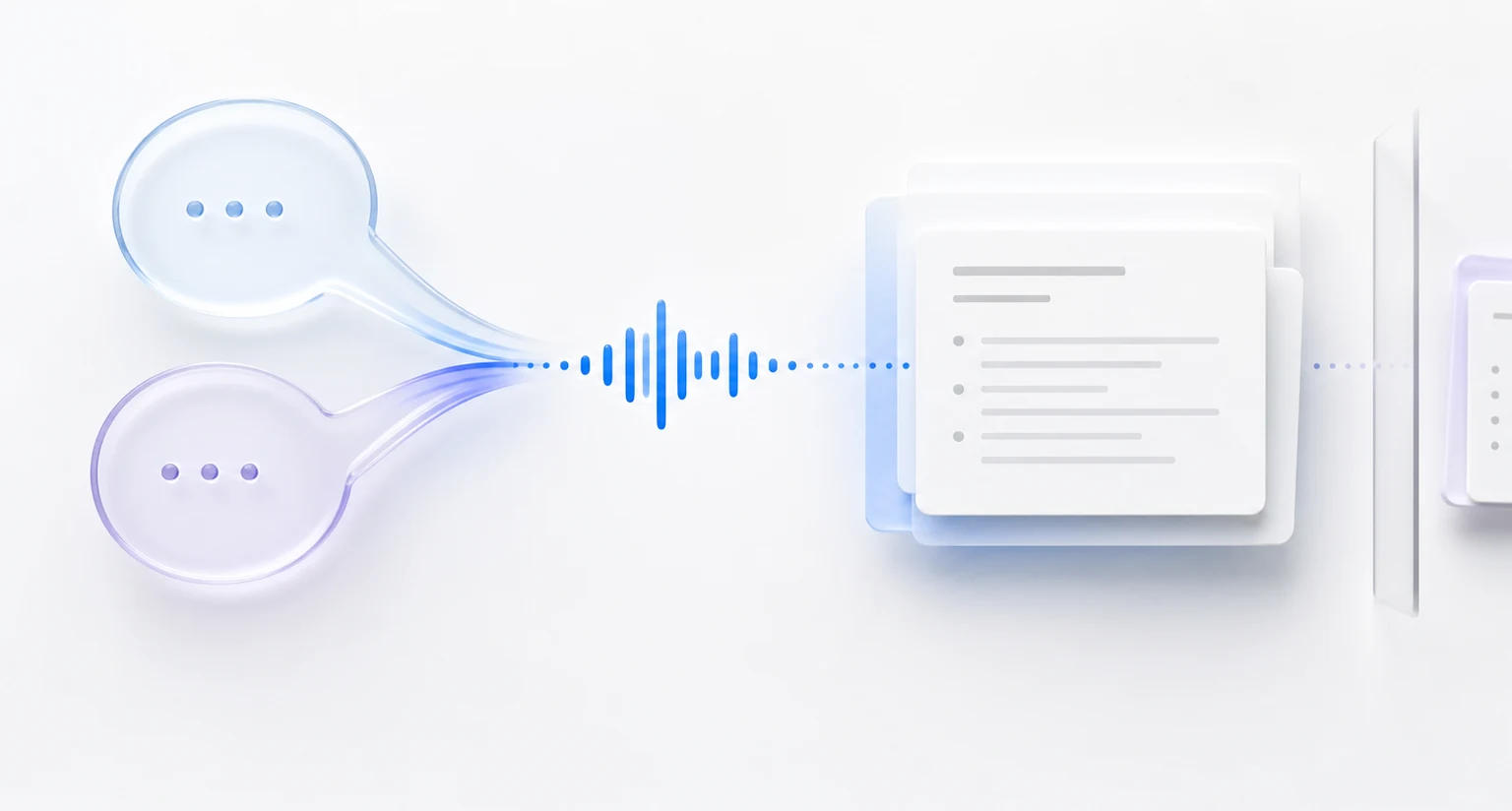
The answer is not a vague note or a verbatim one. It is a structured, source-aware note that distinguishes the patient’s perspective, provider observations, formulation, interventions, response, and next steps. Recording and AI-assisted drafting can support that workflow only after the practice defines what may enter it and the provider reviews every sentence.
Why mental health notes require selective detail
In behavioral health, the narrative is often clinically meaningful. Timing, context, functional impact, the patient’s own explanation, and changes across sessions may matter as much as a symptom label. Flattening that story into a checklist can hide what changed. Capturing every detail can create a different problem: unrelated third-party information, exploratory hypotheses, or disclosures that are not needed for treatment can follow the patient through the record.
A useful progress note aims for selective completeness: enough information to understand the encounter, support the clinician’s reasoning, continue the plan, and meet applicable requirements. It does not preserve sensitive content merely because it was spoken.
This matters when patients can read their notes. A 2025 scoping review of open notes in mental health synthesized 22 studies: many patients reported better comprehension, recall, empowerment, or trust, while a minority reported worry or feeling judged by wording. The evidence supports reader-aware writing, not omission of clinically necessary information.
Use plain, respectful language and make the source of each statement visible:
- Patient report: “Patient reports sleeping approximately four hours nightly for the past week.”
- Collateral report: Identify the authorized source and relevant context rather than presenting the account as settled fact.
- Provider observation: Describe what was observed without assigning motive.
- Clinical assessment: Preserve uncertainty with terms such as “consistent with,” “may be contributing,” or “requires further assessment” when appropriate.
- Plan: State what was agreed, what remains pending, who owns the next action, and the expected timeframe.
Keep progress notes and psychotherapy notes conceptually separate
“Psychotherapy notes” is a defined HIPAA term, not a synonym for every therapy progress note. HHS explains that psychotherapy notes receive special protection when they are recorded by a mental health professional, document or analyze the contents of a counseling conversation, and are kept separate from the rest of the medical record. The definition excludes items such as session times, modalities and frequency, test results, and summaries of diagnosis, symptoms, functional status, treatment plan, prognosis, and progress.
That separation affects access and disclosure. HHS notes that a designated record set can include clinical case notes and SOAP notes, while separately maintained psychotherapy notes are excluded from the HIPAA right of access. Most uses or disclosures of psychotherapy notes require specific authorization, subject to defined exceptions. Other laws and policies may add obligations.
For an assisted-documentation workflow, the operational lesson is straightforward: decide where a piece of information belongs before capturing it. A “psychotherapy” label or custom template does not itself create the legal and technical separation required by policy. If a session contains material that the organization does not permit in a recording or general clinical draft, do not send that material through the workflow.
Organizations should define:
- Which encounter types may be recorded or uploaded.
- Which record is being drafted: the general progress record, a separately maintained psychotherapy note, or another document.
- Whether the selected system is approved for that record type.
- Who may access the source audio, draft, and final content.
- Retention and deletion rules for each artifact.
- How staff handle a session that changes course after capture begins.
Software cannot infer an organization’s intended record boundary from a conversation’s sensitivity.
Write the progress note for care, not surveillance
Mental health notes can affect how future readers perceive a patient. Describe behavior, context, and clinical relevance rather than character. “The patient missed two appointments and described losing access to transportation” is more useful than a global label such as “noncompliant.” Attribute a statement when its source matters, and avoid quotation marks that appear to cast doubt unless the exact words are clinically necessary.
Trauma history calls for particular restraint. SAMHSA describes a trauma-informed approach as one that recognizes trauma’s effects, incorporates that knowledge into practice, and seeks to resist retraumatization. In documentation, that can mean recording the information necessary for current care while avoiding gratuitous scene-level detail, preserving the patient’s language where relevant, and explaining why sensitive information is included.
Risk-related documentation should support the assessment and response. Record material statements, relevant findings and protective factors, actions, consultation or escalation, and follow-up according to scope and policy. Do not let generated prose treat “not assessed,” “not disclosed,” and “denied” as interchangeable or invent a formulation the clinician did not make.
Treat recording consent as part of the therapeutic interaction
Recording a mental health session can change what a patient is willing to say. A peer-reviewed AMA Journal of Ethics analysis of ambient documentation warns that patients may feel pressured to accept recording and may withhold sensitive concerns when they are uncomfortable with it. The authors frame consent as a trust practice, not simply a form.
Before capture, explain in understandable language:
- that the encounter would be recorded or an existing recording uploaded;
- that the purpose is to produce a draft note for clinician review;
- who is expected to have access under the approved workflow;
- what happens to the recording and draft under organizational policy;
- that the clinician remains responsible for the final record; and
- what documentation alternative is available if the patient declines.
Do not imply that agreeing is a condition of receiving ordinary care when it is not. Apply the organization’s process for documenting consent or permission, and account for state recording law, minor-consent rules, guardianship, group or family sessions, telehealth location, and other facts that can change the analysis. Consent to treatment, permission to record, and authorization to disclose information are not automatically the same decision.
A study of collaborative documentation and therapeutic alliance found that clients and providers could experience in-session computing differently. Its findings are not universal, but they reinforce the need to evaluate whether patients understand the tool, can decline without pressure, and still experience the provider as present.
Build a repeatable mental health documentation workflow
1. Choose a structure that fits the encounter
An intake, medication-management follow-up, psychotherapy progress note, crisis contact, and care-coordination encounter need different prompts. Start with the smallest approved structure that reliably captures the purpose, relevant change, intervention, response, assessment, and plan. The principles in choosing a clinical template can be adapted to behavioral health rather than forcing every session into the same form.
2. Confirm permission and the record destination
Confirm the patient, participants, encounter type, recording permission, and intended destination before capture. For couples, family, or group work, follow policy for every participant and for information about people who are not the identified patient.
3. Make distinctions audible
When natural, clarify whether information is patient-reported, observed, obtained from an authorized collateral source, or reviewed from another record. State when a possibility remains under evaluation. Summarize decisions and follow-up near the end. These habits improve the source material without turning the session into dictation.
4. Review in two separate passes
First review clinical fidelity: identity, source, chronology, negation, symptoms, impact, intervention, response, assessment, plan, and risk content. Then review sensitivity: unnecessary trauma detail, third-party information, judgmental wording, unsupported certainty, and the wrong record category. Our guide to reviewing a chart before finalization provides a reusable checklist.
5. Verify the EHR copy
After placing approved content into the correct EHR chart, review it again for formatting, truncation, patient identity, and section placement. A correct draft copied into the wrong patient, field, or encounter is still an incorrect record.
How ChartScribe can support the workflow
ChartScribe can record a patient conversation or accept an uploaded recording, generate an editable draft using SOAP, intake, DWI, or custom templates, and let the clinician revise the result before copying finalized content into the EHR. Its mobile workflow can assign visits to patients, retain visit history, and keep charts synchronized across supported devices. For the capture-to-review sequence, see turning conversations into structured notes.
For a mental health practice, a custom template can provide consistent prompts for the reason for contact, patient perspective, relevant observations, intervention, response, assessment, goals, and next steps. Structure can make missing or misplaced material easier for the clinician to spot. It does not determine which content belongs in the general record, separate psychotherapy notes, or no recording at all.
ChartScribe does not diagnose, select treatment, conduct a risk assessment, obtain valid consent, separate psychotherapy notes by law, decide who may receive information, or autonomously finalize a chart. Generated content is a draft. The clinician must compare it with the encounter, correct errors and omissions, supply their own clinical judgment, and decide what enters the EHR. The organization remains responsible for vendor review, configuration, access, retention, consent procedures, workforce training, and compliance with the laws and professional requirements that apply to its setting.
A final mental health note check
Before finalization, ask:
- Is the patient, encounter, and intended record type correct?
- Are report, observation, collateral information, and clinical interpretation clearly distinguished?
- Does the note preserve uncertainty instead of converting it into fact?
- Are intervention, patient response, progress toward goals, and next actions visible?
- Is risk-related content accurate, specific, and consistent with what was actually assessed?
- Have unnecessary trauma details, third-party material, and stigmatizing language been removed?
- Does any content belong outside the general progress record under policy?
- Was recording permission handled under applicable law and organizational procedure?
- Has the clinician reviewed the final EHR version?
AHRQ’s guidance for shared behavioral health care plans emphasizes patient participation, defined team roles, and explicit discussion of confidentiality concerns in shared records. Those are useful design principles even outside integrated care. The best mental health note is not the longest account of the session. It is a trustworthy clinical document that preserves meaning, limits unnecessary exposure, and makes the next step clear.