

Organizing Patient Visit History for Clearer Review
A reliable patient timeline helps clinicians locate and verify prior decisions, clinical changes, and outstanding follow-up.
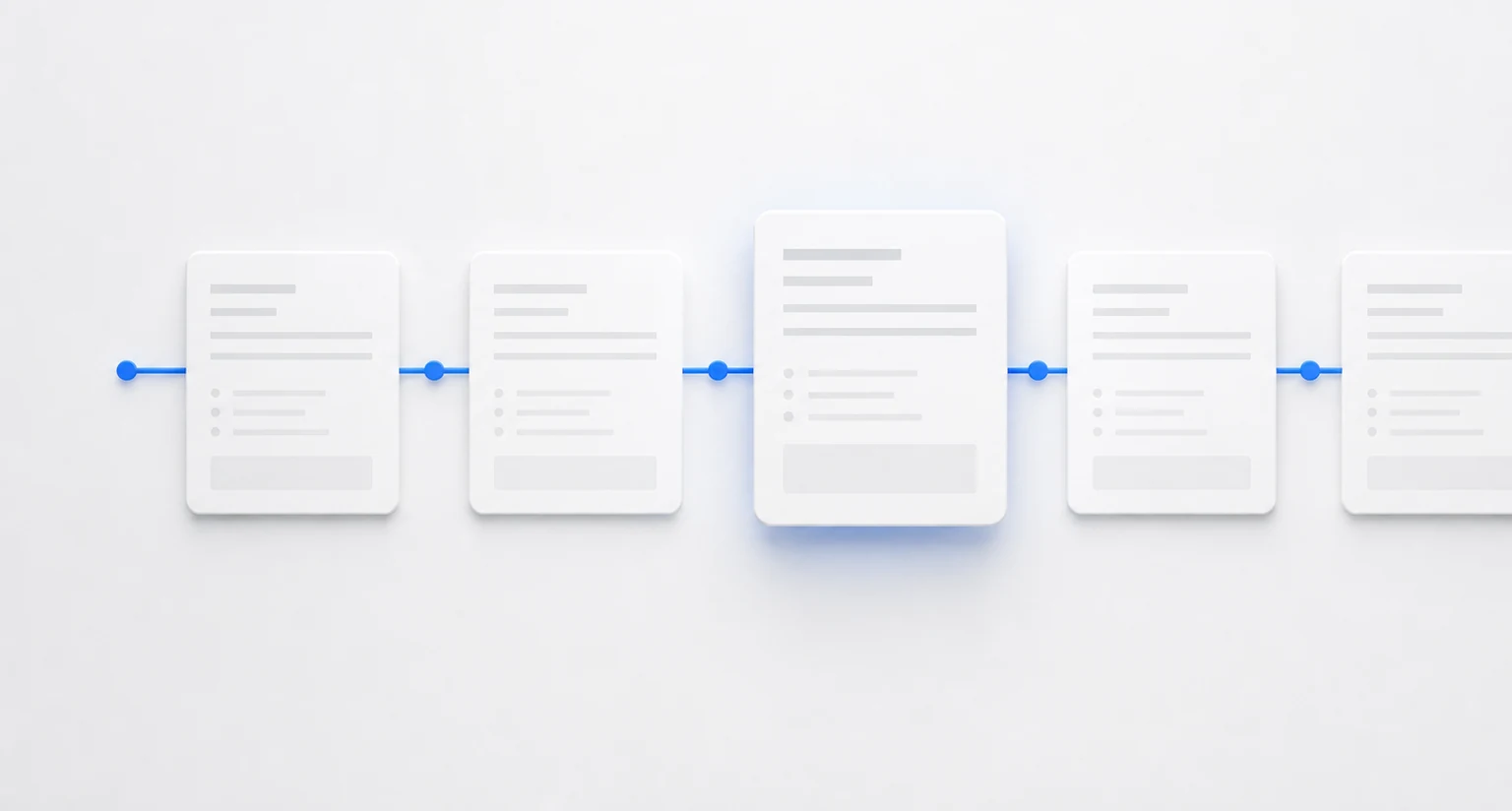
A patient visit history should answer a clinical question quickly: what happened before, what changed, and what needs attention now?
Longitudinal records accumulate notes, messages, results, medication changes, and documents from different settings. Search can find matching words without showing what is current. A problem list can summarize active issues without explaining how the clinician arrived at today's plan.
The goal is not simply to store more documentation. It is to give each encounter a reliable place in the patient's clinical story.
Treat chronology as a patient-safety interface
Continuity has several dimensions. A widely cited multidisciplinary review in The BMJ distinguishes informational continuity—using information from past events and personal circumstances to make current care appropriate—from management and relational continuity. A usable visit history supports that informational dimension without pretending that documentation alone creates a therapeutic relationship or a coordinated care plan.
AHRQ's discussion of EHR-based care coordination highlights both sides of longitudinal data: electronic records can aggregate information across time and sources, but workflow barriers, inconsistent documentation, unstructured text, and limited exchange can still undermine coordination.
For the timeline to help, it needs to make four kinds of information visible:
- Encounter context: when and where care occurred, why the patient was seen, and who documented it.
- Clinical change: what is new, resolved, worsening, uncertain, or unchanged since the prior relevant encounter.
- Decision and reasoning: what the clinician concluded and what evidence or patient preference shaped that conclusion.
- Forward work: what should happen next, who owns it, and how a future reader will recognize completion or escalation.
Give every encounter a clear identity
The safest timeline begins with the correct patient. ONC's 2025 Patient Identification SAFER Guide emphasizes reliable identification because information displayed or entered in an EHR must be associated with the right person. A visit history interface cannot compensate for a chart attached to the wrong record.
Before recording, uploading, drafting, or transferring documentation, confirm the patient using the organization's approved identifiers and workflow. Then give the encounter enough metadata to remain intelligible later:
- date and, when clinically relevant, time;
- visit name or reason for encounter;
- care setting and encounter type;
- author or responsible clinician;
- note status, such as draft, reviewed, amended, or finalized;
- source of imported information when it affects interpretation; and
- links or references to related orders, results, referrals, or prior encounters in the designated record.
Names should be concise and predictable. “Follow-up” is weak when a clinician sees several in one month. “Diabetes follow-up,” “post-discharge medication review,” or “left knee pain reassessment” helps a reader scan before opening a note. Use conventions that match the organization's EHR and specialty.
Show what changed without erasing what came before
A good history balances two views:
- a current snapshot of active problems, medications, allergies, risks, and care-plan elements in the EHR; and
- a chronological record showing how those items and the clinical reasoning changed over time.
The current snapshot supports quick orientation. The encounter timeline provides provenance and explanation. They should reinforce each other, but one should not be treated as a substitute for the other.
When reviewing a prior visit, look for explicit change language: started, stopped, increased, decreased, improved, worsened, pending, declined, or referred. Include dates and relevant measurements where they influence interpretation. If the evidence is incomplete, document the uncertainty rather than converting it into a definitive historical fact.
For repeated visits, preserve stable background in the appropriate EHR fields and keep the encounter note focused on today's state and decisions. This reduces the chance that important changes disappear inside paragraphs of unchanged material.
Control copied-forward information
Reusing information can save time and preserve necessary context, but copied text can also propagate outdated findings, obscure the author and date of an observation, or make a note appear more current than it is. A systematic review and expert recommendations on copy and paste in EHRs identified patient-safety risks and emphasized practices that support accurate attribution, review, and monitoring.
Use prior documentation as a reference, not as an unquestioned template. For any carried-forward statement, ask:
- Is it still true?
- Was it verified today, or is it historical?
- Does the source and date matter?
- Would a future reader know what changed?
- Does this information belong in the encounter note or in a maintained EHR field?
Generated drafts require the same discipline. A structured section can make text easier to find, but its placement does not prove its accuracy. The responsible clinician needs to compare the draft with the encounter, correct errors, remove unsupported content, and make the final record reflect current clinical judgment.
Use search as a shortcut, not as the structure
Search is valuable when the underlying visit history is organized. It can help locate a patient, a visit name, or a phrase across prior documentation. It is less reliable when encounters are inconsistently named, notes lack dates or status, or the same content appears in many copied records.
Give users more than one route to the information:
- a patient-level chronological list;
- consistent visit names and dates;
- filters for clinically useful attributes available in the approved system; and
- search for a known patient or encounter term.
The timeline should remain understandable when search returns nothing. A result should also return the user to the chronology so they can see what came before and after the matching note.
Make follow-up visible across visits
An organized history is most valuable when it supports work that spans encounters. Pending tests, referrals, medication trials, and safety-net instructions should not become passive prose that no one is assigned to revisit.
ONC's 2025 Clinician Communication SAFER Guide focuses on reliable electronic communication among clinicians, care teams, and patients, including transitions such as referrals and discharges. The record should support—not replace—the organization's processes for routing, acknowledgment, escalation, and closed-loop follow-up.
For each forward-looking item, document what is expected, the responsible person or team, the intended timeframe, and what should happen if the result or response does not arrive. At a subsequent visit, update the status instead of merely repeating the old plan. If ownership changes, make that change explicit through the appropriate workflow.
Protect the history while making it available
Longitudinal access can improve care, but it also exposes a broader span of sensitive information. Use authenticated, organization-approved systems and role-appropriate access. Avoid moving patient timelines into personal note apps, unapproved storage, or informal messages.
The HIPAA Privacy Rule's minimum necessary guidance generally requires reasonable efforts to limit certain uses, disclosures, and requests, while also explaining important exceptions, including disclosures to or requests by healthcare providers for treatment. Organizations should translate the rules that apply to their work into practical access and disclosure policies; individual users should not guess.
A ChartScribe workflow for an orderly timeline
The ChartScribe mobile app supports assigning visits to patients, keeping documentation organized by patient, searching across patients and visit names, and returning to previous visits on supported devices. Clinicians can record or upload an encounter, generate a structured draft, review and edit it, and copy finalized content into the EHR.
Those capabilities are intended to limit reliance on memory or unofficial reminders. A patient-centered list and predictable visit names provide a consistent way to look for the relevant draft, while structured output places similar information in similar sections across encounters. Organizations should test whether that design improves retrieval and comparison in their actual workflow rather than assuming the outcome.
ChartScribe is not the legal source of truth for patient identity, medication reconciliation, results management, or the final medical record. The clinician must select the correct patient, verify the encounter details, review every generated statement, and transfer the approved content to the correct EHR chart. The organization remains responsible for identity controls, access, retention, correction, and follow-up processes.
Related workflows include Turning Patient Conversations Into Structured Notes, Designing Documentation for Continuity of Care, and reviewing a chart before finalization.
A practical review standard
Before finalizing an encounter, check that a future reader can answer:
- Why did this visit occur?
- What changed since the last relevant encounter?
- Which findings were observed today, reported by the patient, or imported from another source?
- What clinical reasoning connects the evidence to the assessment?
- What was decided, including patient preferences or declined options?
- What remains pending, who owns it, and when should it be revisited?
- Is the note attached to the correct patient and encounter?
Then periodically test the system itself. Ask clinicians to find a prior decision, medication change, or pending follow-up in a realistic patient history. Note how long retrieval takes, where users hesitate, and whether they open the correct encounter. Those observations can reveal naming, workflow, or training problems that a database completeness check will miss.
A useful visit history is not the longest record. It is a trustworthy chronology in which identity, change, reasoning, and next actions are visible when care moves forward.