

Turning Patient Conversations Into Structured Notes
A safe, clinician-led workflow for converting recorded encounters into organized draft notes while protecting context, accuracy, and patient trust.
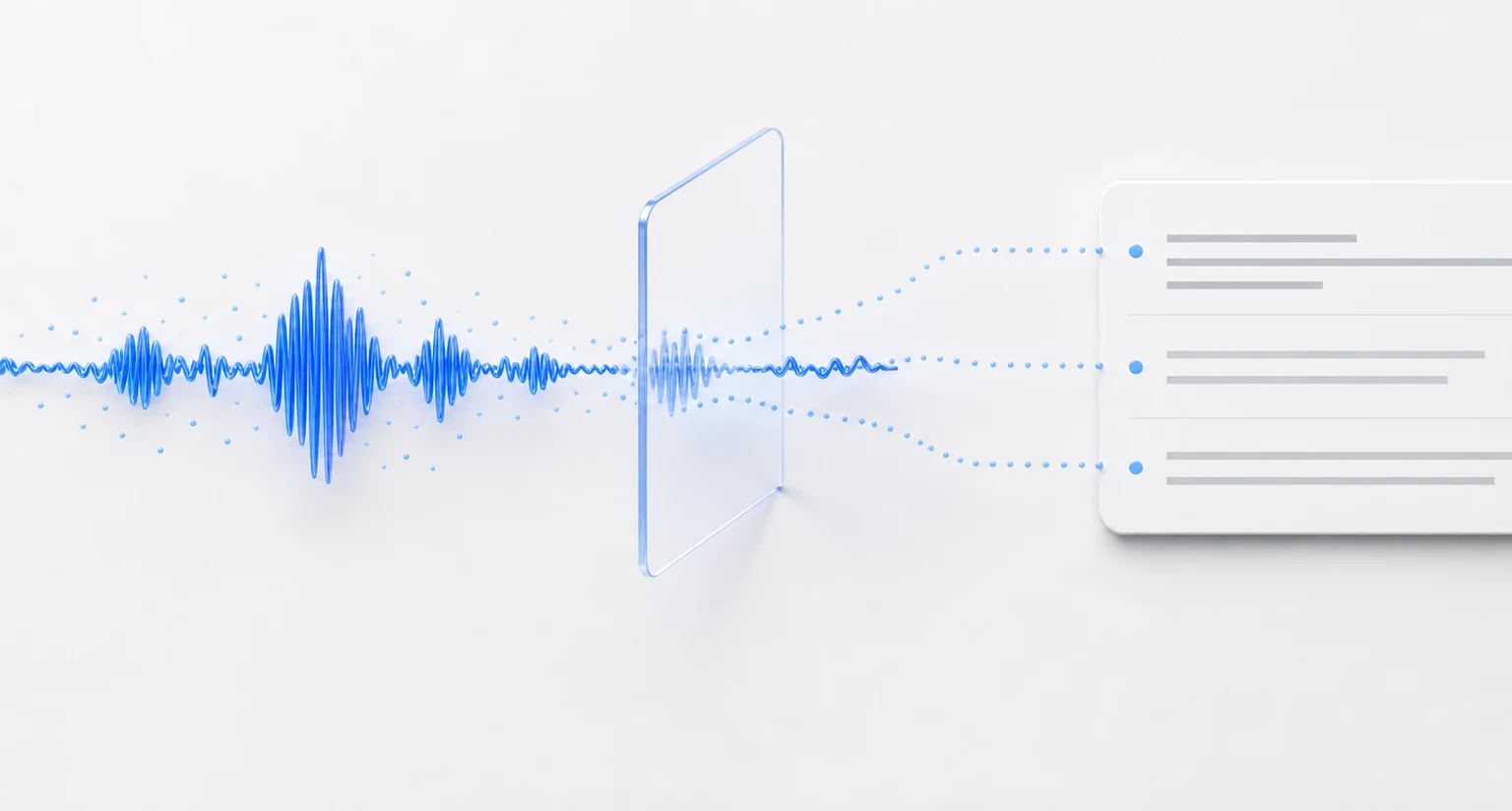
A clinical conversation and a clinical note serve different purposes. The conversation is exploratory: patients tell stories out of order, clinicians ask follow-up questions, possibilities are considered, and plans change as new information emerges. The note must turn that exchange into an accurate, organized record of what was relevant, what the clinician concluded, and what will happen next.
That transformation is not transcription. A transcript preserves words and sequence. A structured note selects, attributes, organizes, and synthesizes information. Each of those steps creates an opportunity to help the clinician—and a chance to lose context or introduce error.
A safer approach to conversation-to-note technology is a clinician-led workflow. Software prepares an editable draft. The clinician verifies the source, supplies clinical judgment, and decides what enters the record.
Why conversations are difficult to structure
Patient encounters contain ambiguity that may be easy for a participant to understand and hard for software to resolve later.
Pronouns can refer to the patient, a family member, or another clinician. A statement about a medication might describe current use, a previous trial, an allergy, or a question. Negation can change the entire meaning of a sentence. A number may be a dose, a measurement, a date, or an estimate. The clinician may discuss a diagnosis as one possibility before downgrading its likelihood or ruling it out, while a note that strips away conversational context can make that possibility sound confirmed.
Not everything spoken belongs in the medical record, and some important work is not fully verbalized. Physical examination findings, reviewed results, clinical reasoning, and the final status of a plan may need deliberate confirmation. Side conversations and sensitive disclosures may require special handling. A fluent summary can still be incomplete or wrong.
This is why “the draft reads well” is not a sufficient quality check.
What the evidence says—and does not say
Early real-world studies suggest that ambient documentation can reduce parts of the documentation burden. For example, a 2025 quality improvement study of an ambient AI documentation platform found an association with less time in notes per appointment and improved clinician-reported experience, but it was a nonrandomized pilot at one health system. It did not establish that every tool, specialty, or organization will achieve the same result.
Other research makes the safety boundary clear. A comparative evaluation of four commercial scribes using simulated encounters found that omissions accounted for most identified errors, with additions and incorrect facts also present. A randomized clinical trial of ambient scribes reported clinician concerns including omissions, formatting and structural problems, pronoun-resolution errors, and other inaccuracies in AI-generated draft notes.
These findings should not be used to assign an error rate to ChartScribe or to a particular clinical deployment; the studies evaluated other tools, settings, and workflows. They do show why organizations should evaluate a tool locally and why no generated draft should bypass clinician review.
The AMA’s guidance on using health AI in the exam room similarly emphasizes verification, transparency, and continued physician responsibility. The appropriate mental model is assistance with documentation—not autonomous charting or clinical decision-making.
Before capture: establish a safe source
The quality of a draft begins with the conditions under which the encounter is captured.
Follow the organization’s approved process for privacy, security, disclosure, and consent, as well as applicable law. Requirements can vary by jurisdiction and context. Patients should understand that technology is being used to help draft documentation, who remains responsible for the record, and what alternative is available if they decline. The AMA Journal of Ethics discussion of ambient listening, consent, and the patient-clinician relationship explains why consent should be treated as an ongoing trust practice rather than a silent checkbox.
Use only tools, devices, and storage processes approved by the organization. Reduce avoidable audio ambiguity: position the device appropriately, limit background noise where possible, identify additional speakers, and do not leave capture running into unrelated conversations.
Choose the note template before generation. A routine follow-up, intake, imaging report, and SOAP note ask different questions of the same conversation. The template should match the encounter rather than force the encounter into a familiar but unsuitable structure; use this clinical template selection framework when several formats appear plausible.
During the encounter: make distinctions explicit
Clinicians should not perform for the recording, but several natural habits can improve both communication and documentation:
- Identify who supplied important history when it was not the patient.
- State medication actions precisely: start, stop, continue, increase, decrease, or hold.
- Distinguish a patient-reported value from a result reviewed in the record.
- Clarify when a diagnosis is historical, suspected, ruled out, or confirmed.
- Summarize the agreed plan and follow-up near the end of the visit.
- Add examination findings or decisions that were not otherwise spoken.
These habits are useful even without an AI tool because they reduce misunderstandings between patient and clinician. They also give a generated draft a better source from which to work.
After generation: review by risk, not just by section
Reading from the first line to the last may miss a confident-looking error. The passes below focus specifically on errors that can arise while speech is converted into structured prose; clinicians should still complete the broader final chart review workflow before signing.
Pass 1: encounter identity and scope
Confirm the patient, date, encounter type, participants, and reason for the visit. Make sure the draft did not pull in discussion that occurred before or after the intended encounter. If an uploaded recording was used, verify that it is the correct file.
Pass 2: source fidelity
Compare the draft with the encounter while looking for three categories: unsupported additions, clinically relevant omissions, and statements whose meaning changed. Check speaker attribution, negation, chronology, and certainty. Preserve distinctions such as “patient reports,” “outside record notes,” and “clinician observed.”
Pass 3: high-risk facts
Recheck names of medications, allergies and reactions, doses, units, routes, frequencies, measurements, dates, laterality, pregnancy status where relevant, and the state of diagnostic results. Never infer a normal finding because it would be typical, and never convert a discussed option into an order or completed action.
Pass 4: clinical reasoning
The assessment and plan must express the clinician’s own reasoning. Confirm that each assessment is supported by the recorded history and findings, that uncertainty is preserved, and that the plan maps to the problem addressed. Add reasoning that was clinically important but not explicit in the conversation; remove model-generated interpretation that the clinician did not make.
Pass 5: open loops and readability
Verify referrals, tests, patient instructions, return precautions, follow-up timing, and ownership. Then remove repetitive or irrelevant content. AHRQ has documented how autopopulated and copied text can perpetuate errors; generated prose deserves the same skepticism as any other reused content.
From conversation to draft in ChartScribe
ChartScribe allows a clinician to record an encounter or upload an existing recording, including through its mobile documentation workflow, select a SOAP, DWI, intake, or custom template, and generate an organized draft. The clinician can edit and review that draft, then copy the finalized note into the EHR.
This workflow can move the first pass of documentation from a blank page to a structured starting point. It does not determine diagnoses, recommend care, verify that an event occurred, or sign the chart. ChartScribe output should never be treated as authoritative solely because it is polished or organized.
A practical operating rule is simple: no draft enters the EHR until a qualified clinician has checked it against the encounter and made it their own. The pre-finalization chart review checklist provides a repeatable version of that check. After copy and paste, review the EHR version again. Formatting changes, truncated content, incorrect placement, or text left in the clipboard can create a new error after the draft itself was corrected.
The safety boundary is part of the product workflow
Organizations adopting conversation-to-note tools should define who may use them, for which encounter types, how consent is handled, what information must be verified, how problems are reported, and how performance is monitored over time. High-risk or unusually complex encounters may require a different workflow.
The clinician remains responsible for the accuracy, relevance, and completeness of the final record. The North Carolina Medical Board’s current position on medical records and AI-assisted transcription is one clear example of a regulator placing accuracy responsibility on the licensee. Clinicians should consult the requirements that apply in their own jurisdiction and organization.
Structured drafts can give clinicians a better place to begin. Clinician verification, judgment, and approval are necessary safeguards, but they do not make every generated draft or deployment risk-free.