

Choosing the Right Clinical Documentation Template
How to match a clinical note template to the encounter, specialty, reader, and workflow without creating boilerplate or missing critical details.
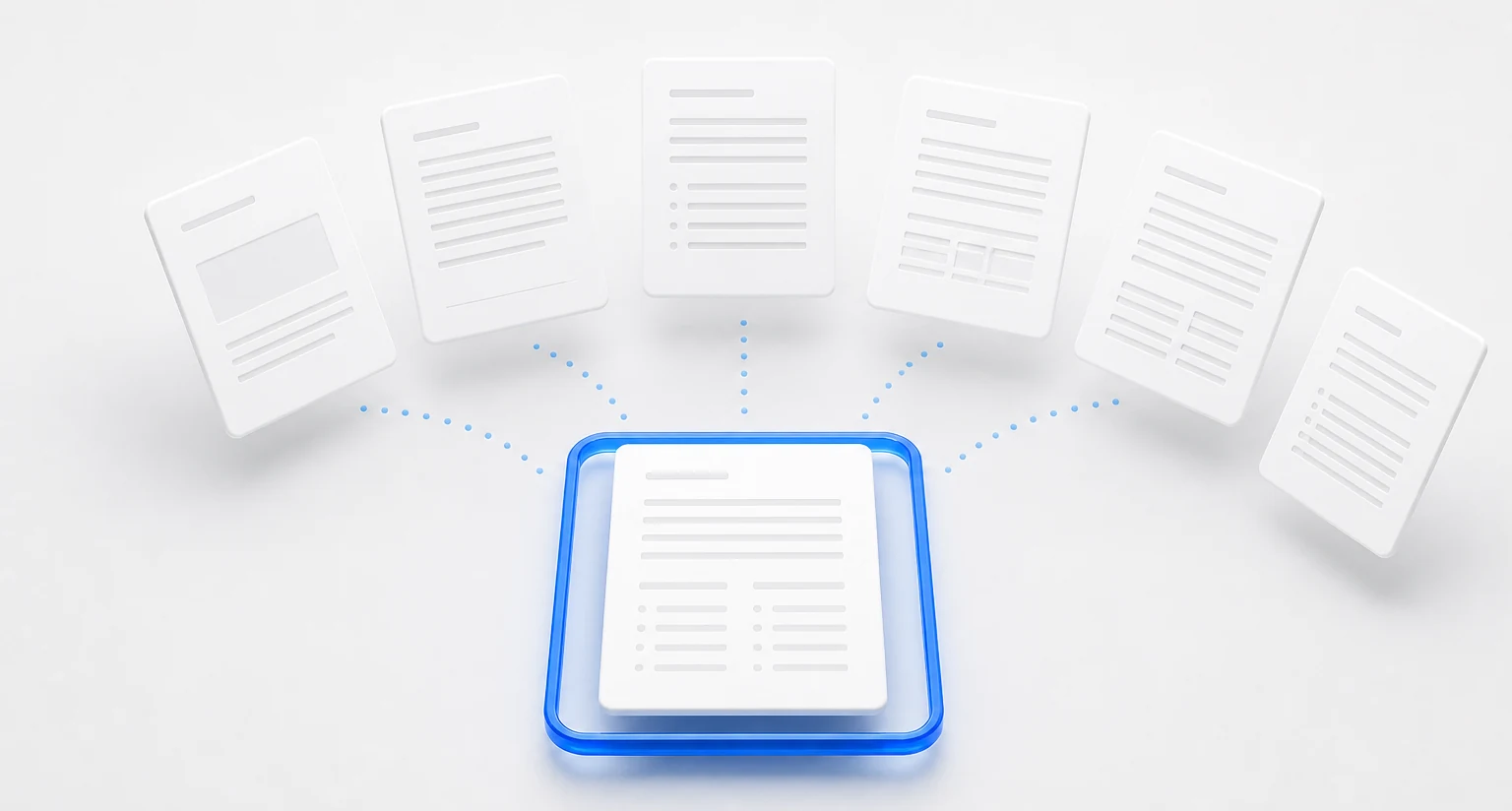
Clinical templates solve a real problem: no clinician should have to rebuild the structure of a familiar note from scratch for every encounter. But a template can create a second problem when its prompts do not match the visit. The author works around irrelevant sections, the note fills with default language, and the current clinical story becomes harder to find.
The right template is not necessarily the most detailed one. It is the smallest structure that reliably prompts for the information needed to understand, continue, and account for that kind of care.
Choosing well requires more than deciding between SOAP, intake, or a specialty form. It means matching the template to the encounter’s purpose, the clinician’s reasoning, the next reader’s needs, and the rules that apply to the setting.
Why template fit matters
Structured documentation can improve consistency, but structure is not automatically quality. A multicenter study of structured and standardized clinical documentation found an association with improved note quality while also describing the tension between structured fields and the narrative flexibility needed for different workflows and content.
Template design also changes what readers notice. In the randomized NOTE trial of outpatient templates, researchers tested a redesigned format that moved assessment and plan forward, grouped related content, and deemphasized less useful elements. The intervention was not simply “more fields.” It was an attempt to prioritize information according to clinical use.
The risk on the other side is note bloat. A review in AHRQ Patient Safety Network explains how copied and autopopulated EHR text can preserve outdated or wrong information and make the record less trustworthy. A template that begins with completed normal statements or imports every available result asks the clinician to hunt for what should be removed. A safer template asks for current, relevant content and leaves unsupported fields empty.
Start with the encounter, not the template library
Before selecting a format, define what happened and what the note needs to do.
What is the purpose of this visit?
A comprehensive intake, a focused same-day complaint, a chronic disease follow-up, a procedure, and a diagnostic imaging report are not interchangeable documentation tasks. Each has a different balance of history, findings, interpretation, and follow-up.
SOAP may be a strong fit when the reader benefits from a progression from patient-reported information through findings to assessment and plan; our guide to building a better SOAP workflow explains the cross-section checks that format needs. An intake template may need more explicit medical, medication, social, and family history. A diagnostic imaging template needs a disciplined distinction between technique, findings, comparison, and impression. A brief follow-up may need to foreground what changed since the previous visit and whether the existing plan is working.
Who will use the note next?
Consider the immediate reader: the same clinician at the next visit, a covering clinician, a referring professional, a billing or quality reviewer, or the patient. The validated QNOTE framework treats clear, current, organized, prioritized, concise, and sufficient content as dimensions of quality. A good template should help the author deliver those qualities to its real audience.
If the reader must make a handoff decision quickly, burying assessment and plan beneath pages of stable history is counterproductive. If longitudinal change is central, the template should make baseline, interval change, current status, and next review easy to compare.
What requirements apply?
Templates should reflect current organizational policy, specialty standards, payer requirements, and applicable law—not remembered folklore about what a note “has to” contain. CMS’s E/M documentation guidance emphasizes relevant history and findings, assessment or diagnosis, rationale for services, and the plan of care. It also notes that documentation must support the services and codes reported.
That does not mean every encounter should use a CMS-oriented template, nor that a generic template assures compliance. Requirements differ by service, payer, setting, profession, and jurisdiction. Clinical and compliance owners should approve the actual fields used by the practice.
Evaluate a template with six questions
Before adopting a template, test it against real representative encounters:
- Does every section have a clear purpose? If authors routinely leave a field blank or paste “not applicable,” it may not belong in the default view.
- Does the structure distinguish sources? Patient reports, caregiver observations, clinician findings, outside records, and clinical conclusions should not blur together.
- Does it foreground what changed today? Current problems and decisions should be easier to find than stable background information.
- Does it make high-risk details explicit? Medication changes, allergies, measurements, laterality, pending tests, follow-up ownership, timing, and precautions deserve deliberate prompts where relevant.
- Does it allow uncertainty? A template should support working diagnoses, differentials, pending information, and “not assessed” rather than forcing false certainty.
- Can a clinician remove irrelevant sections cleanly? Optional content should disappear rather than leaving empty headings or default assertions in the final note.
These questions prevent a common template failure: confusing consistency of appearance with consistency of care.
When a custom template is worth building
A custom template is useful when a practice repeatedly documents the same type of encounter and a general format requires substantial rework. Examples include a specialty follow-up with a stable set of condition-specific measures, a procedure note with defined safety elements, or a report with an established order of findings.
Condition-specific templates can improve targeted documentation when they are thoughtfully designed. A multiclinic study of standardized, condition-specific neurology templates found improved adherence to quality metrics without an increase in note time, although the authors’ setting and learner population limit how broadly that result should be applied. The useful design principle is expert governance: the templates were developed around specific conditions and reviewed for usability rather than assembled from every conceivable field.
Build a custom template in layers:
- Core: information needed in nearly every encounter of this type.
- Conditional: prompts shown or used only when relevant.
- Narrative: space for context, reasoning, uncertainty, and exceptions.
- Safety: explicit prompts for high-risk facts and open follow-up loops.
- Operational: fields required by the organization or applicable workflow.
Avoid default-positive or default-normal language. Use prompts such as “Document findings assessed today” instead of prefilled statements such as “All systems normal.” Keep instructions out of the final note, and review whether data already available elsewhere in the EHR needs to be repeated at all.
Pilot before standardizing
Template governance is a clinical quality activity, not a one-time formatting project. Pilot a proposed template with a small group across routine and edge-case encounters. Have both authors and downstream readers assess it.
Useful review measures include:
- editing required before finalization;
- missing or misclassified information;
- repeated or irrelevant text;
- ease of finding assessment, decisions, and follow-up;
- performance with complex, multilingual, remote, or multi-speaker encounters;
- alignment with current specialty, compliance, and organizational requirements.
Track what clinicians delete as closely as what they add. Repeated deletion often reveals a field that is too broad or a default that is unsafe. Repeated free-text additions may reveal a missing prompt. Assign an owner and a review date so old workflows do not become permanent boilerplate.
The ONC Clinician Communication SAFER Guide offers a useful systems perspective: communication safety depends on how technology, policy, and clinical workflows work together. A template should therefore be evaluated in the actual handoff and follow-up process, not only on how it looks at the moment of authorship.
Using templates with ChartScribe
ChartScribe lets a clinician record a patient conversation or upload an existing recording, then select from its SOAP, DWI, intake, or custom templates before generating a structured draft. Choosing the destination first gives the draft an encounter-appropriate shape instead of starting from a generic page. Teams should evaluate whether that structure actually reduces reorganization in their own workflows.
The generated note remains a draft. The clinician must verify it against the encounter, remove unsupported or irrelevant content, add necessary context, and confirm that the assessment and plan reflect the clinician’s own judgment. After editing, the finalized text can be copied into the EHR, where it should be reviewed again for formatting and completeness before signature.
ChartScribe does not determine which template satisfies a specialty rule, make clinical decisions, or turn a template into proof that required care occurred. Template approval and final documentation responsibility remain with the clinician and organization.
The best template is not the one that produces the fullest page. It is the one that consistently helps the clinician capture what happened, explain what it means, and make the next action clear—without making the reader excavate the answer. That same reader-first principle is central to documentation designed for continuity of care.